Urban regeneration is one of the greatest design challenges in today’s rapidly evolving cities — especially in regions with deep historical layers like Iran. Architects and planners are often tasked with reviving forgotten or deteriorated urban fabrics while integrating contemporary needs. The key to success in these projects lies in balancing heritage preservation with innovative design.
At Ahmadreza Sahami Studio, our approach focuses on creating spaces that honor the spirit of place while providing meaningful functionality for future generations.
1. Why Urban Regeneration Matters
Many historic urban areas suffer from neglect, underuse, or structural decay. Yet these neighborhoods often hold cultural value, social memory, and spatial wisdom embedded in their geometry.
Urban regeneration projects:
- Revitalize economic activity
- Rebuild community life
- Preserve architectural identity
- Prevent sprawl and unsustainable development
For cities like Isfahan, Yazd, or Shiraz, regeneration is not just about building anew — it’s about continuing the story of the place.
2. The Role of Traditional Urban Logic
Iranian cities have long relied on intelligent spatial systems:
- Courtyard houses (hojreh) for passive climate control
- Bazaar-based commercial centers with shaded, linear access
- Windcatchers (badgir) for natural ventilation
- Narrow, shaded alleys for thermal comfort and privacy
These traditional elements are not outdated; they are ecological, communal, and adaptable. In our design practice, we don’t replicate them literally — we reinterpret their logic for contemporary life.
3. Strategies for Harmonizing Old and New
Some key principles in our design process include:
a. Adaptive Reuse
Instead of demolishing old structures, we retrofit them for new functions. A traditional caravanserai may become a co-working space or gallery.
b. Material Continuity
We use local and familiar materials — brick, adobe, lime plaster — combined with modern construction techniques.
c. Respecting Scale and Rhythm
New buildings are designed to respect the height, proportions, and rhythm of the historic surroundings.
d. Layered Public-Private Transitions
We recreate traditional urban transitions (like semi-open courtyards, thresholds, and passageways) to preserve the neighborhood’s sense of intimacy.
4. Case Example: Cultural Complex in a Historic Urban Block
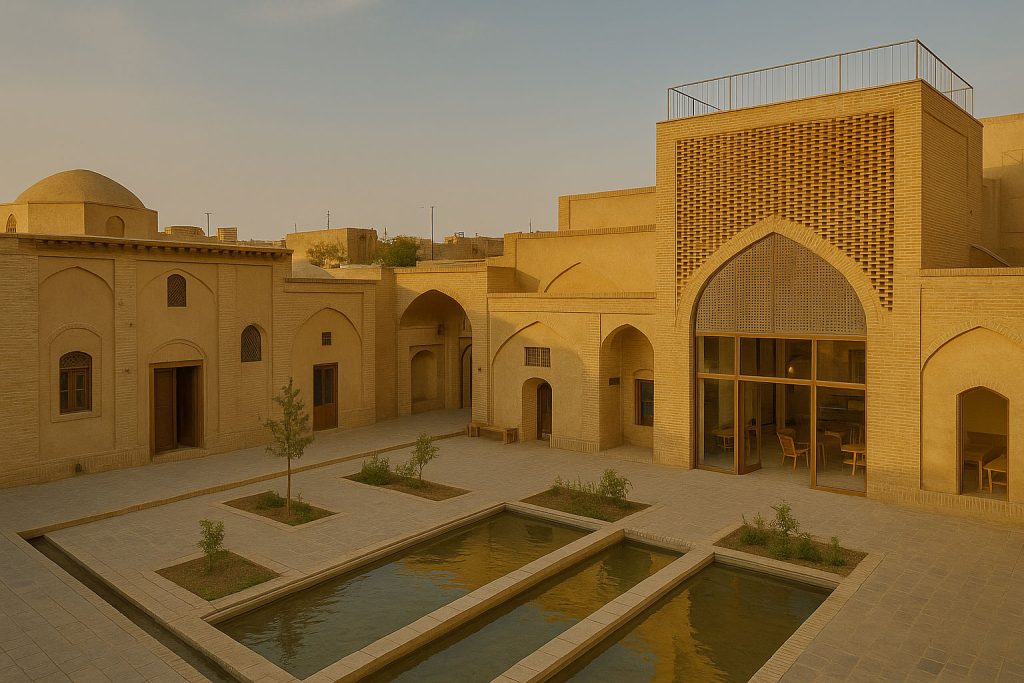
In one of our urban projects in central Isfahan, we transformed a decaying residential cluster into a multi-use cultural complex. The strategy involved:
- Preserving two Qajar-era houses as exhibition and workshop spaces
- Introducing new infill buildings with a minimalist clay-brick façade
- Recreating a traditional water feature and planting native vegetation
- Ensuring permeability through alleys and shared courtyards
The result was a vibrant cultural node that respected the past while being fully rooted in the present.